
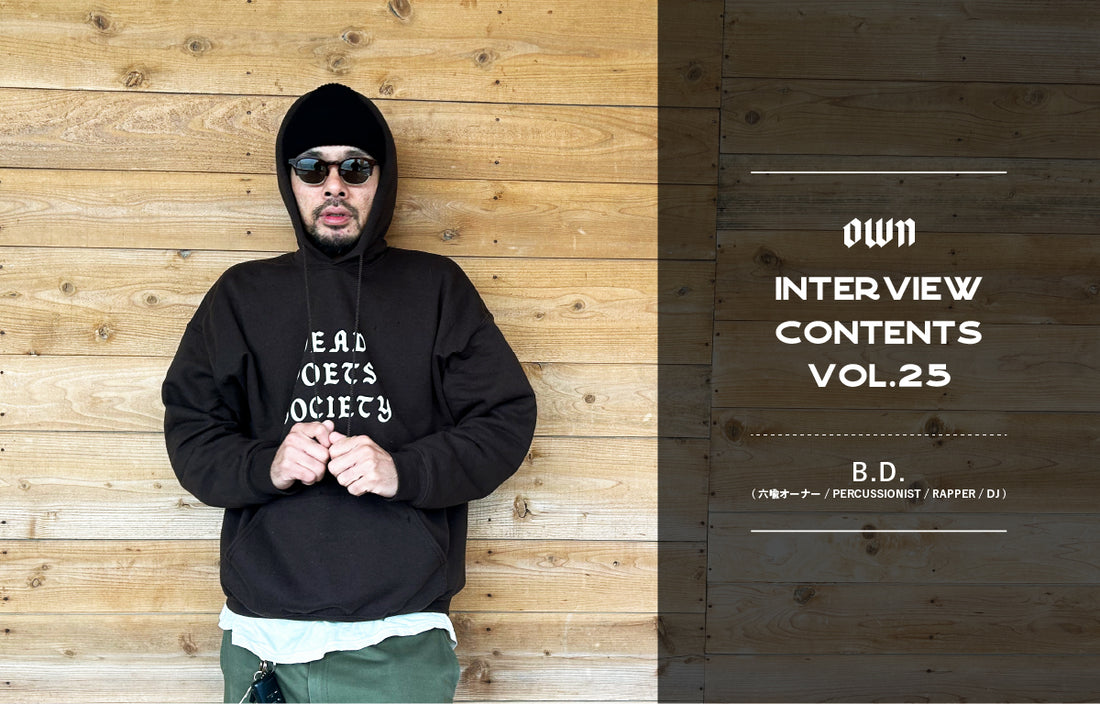
OWN INTERVIEW CONTENTS Vol.25 BD (Rokuyu Owner / Percussionist / Rapper / DJ)

OWN (hereinafter, O): First, please introduce yourself, or give us a brief profile.
BD (hereafter, B): I'm an artist under the name BD, and I run a shop called Rokuyu in Tochigi Prefecture. I guess the start of my career would have to be GROWAROUND in Shibuya. Before that, I worked at a record store in Ikebukuro. Anyway, I ended up working at GROWAROUND for about 20 years. My career as a rapper started with THE BROBUS. I started rapping in my teens, but it wasn't until 2004 that I released a proper work. From there, I joined TETRAD THE GANG OF FOUR, which then transformed into THE SEXORCIST.
What year was your solo debut?
B: I released "BLACK TALON RECORDINGS" under the name "BD THE BROBUS" in 2008. From there, I released the albums "ILLSON" in 2012 and "BALANCE" in 2013.

You were born in Tokyo and worked in the music industry there. How did you end up moving to Kuroiso, Tochigi Prefecture?
B: First of all, my wife's hometown is here (Tochigi). Also, my father was born in Shirakawa, Fukushima. It's the next town over from Kuroiso. I think I was drawn to it for these reasons (laughs).
OI feel like there's something fateful about this.
B : That's true. But I never thought I'd live in Kuroiso and run my own restaurant like this. But, you know, a lot of things happened at the time... Like the Great East Japan Earthquake on March 11th.
Even though you were living and working in Tokyo, your feelings were changing.
B: My own child was attending elementary school in Tokyo, but with all the things that were going on, I started to wonder what I should do in the future. To be more realistic, I wondered what would happen next in my apartment life in Tokyo... Yeah, I was thinking about a lot of things at the time. I was born and raised in Tokyo, so I was fine with that lifestyle, but I started to feel like I wanted to show my child a slightly different view. From there, I gradually began to think that maybe it would be a good idea to change my environment.
Did you have any desire to live outside of Tokyo?
B: Actually, that was part of it. People get jealous when I say "Tokyo is my hometown," but I've always thought I was more envious of people who have a hometown. It's good to have a place to go back to. Most people probably aspire to live in the city, but I've often longed for the countryside. I think that my values and way of thinking come from my experiences visiting my father's hometown of Shirakawa as a child.
Did you move to Kuroiso during the GROWAROUND era in Shibuya?
B : That’s right. I was still working at GROWAROUND. I started moving from there and built my own house in Kuroiso. That was about seven years ago.
Q: At that time, did you move from Tochigi to Tokyo for work and musical activities?
B: I live half in Tochigi and half in Tokyo. And while I was living in Tochigi, I started to wonder if I could leave something behind here too. While I was thinking about that, I came across this street in Kuroiso and Shozo-san, the owner of this place.
OThe place where Rokuyu is now located was originally called "SHOZO Music Room." Did you know this place existed?
B I didn't know much about it, but I did come to hang out because Japanese legends like Minako Yoshida and Tadashi Kosaka had performed there.
O Are you Tadashi Kosaka from "Enamel"?
B : Yes. Actually, many famous people have performed here. Ever since I saw Minako Yoshida perform live, I thought this place was great and I loved it. That's how I wanted to do something here too, so I held a few events there. I installed a system, invited MURO, and performed with the SUKIMONO BAND I was in. While I was doing all that, the COVID-19 pandemic hit, and this place was left unused. I was looking for a property at the time, and then, to my delight, they contacted me.
Oh wow! The timing was perfect.
B: I was surprised because I had always wanted to do something here. Maybe word had been going around that I was looking for a property. I looked at a lot of different properties, but I thought this was the place where I could quickly turn what I wanted into reality. Also, being able to produce a certain amount of noise is really big. The neighborhood has known this place for a long time.
It's great to be able to make sound, including in my O- Band activities.
It's B. In Tokyo, you'd get reported right away, but here, you don't get any complaints unless you work really late.
OIt 's the best environment.
B: The location was decided, but I took action before deciding on the contents of the store, so I left GROWAROUND at that point. I had been in the apparel industry for a long time, but in the end, I think I just couldn't become a part of the fashion industry. I love clothes, but I can't continue in the business of following trends and selling them. I realized that I wanted to be an artist after all.
O: At that time, you were in your late 30s, right? Did your way of thinking change as you got older?
B I followed the cutting edge of hip hop fashion, buying things in New York, buying a ton of sneakers and selling a ton of them. But I realized I couldn't keep doing this forever. I wanted to pursue the things I love, but if I was going to run a clothing store, I'd have to sell things I don't really like. So I started thinking about opening my own store and doing what I love.
Now , please introduce your shop, Rokuyu, to us again.
B: Personally, I think of Rokuyu as a music-related second-hand shop (laughs). The entrance is a record store, but as you can see, we also have clothes, records, CDs, boomboxes, and tapes. 


There are also music -related books.
B : Yes. My tastes are quite biased when it comes to books, but I like music, art, and sci-fi crime mysteries (laughs).
It feels like the items are selected based on BD 's personal tastes.
B: I think the store has a certain "black" core. Whether it's good or bad is up to the customers to decide, but when you run a store by yourself, it can get a little biased.
Is it like a select shop by BD ?
B : That may be true. I don't have any particular criteria for selecting, but I'm not a connoisseur, but I just buy things that catch my eye. Some of the records I buy are given to me by collectors, and I also ask my overseas friends who are buyers. Marcy and the other members of the Riverside Reading Club helped me with the books.
There are a variety of things here, but it seems to have a certain unity to it.
B: I wonder, maybe that's what I meant by "blackness" as I mentioned earlier. But "blackness" has many meanings. Does it refer to skin color, or that kind of music? Is it simply a color, or is it a certain emotion? I hope everyone can enjoy it in their own way.
Earlier you mentioned "recycle shop," but why did you decide to sell second-hand items?
B: For some reason, I've always felt more attached to used items than new ones. Maybe it's because they have a certain charm that new items don't have. I've always liked second-hand clothes.
O BD hasn't always worn what's commonly called rapper-like fashion.
B : That's right. I started to like hip hop, started rapping and DJing, and then I went to New York, the birthplace of hip hop, and I felt something. I think it's really cool when black people wear street fashion with matching colors, but I thought it was really funny for me, a Japanese person, to do that exactly. To put it in a bad way, it's like cosplay.
O himself felt that simply imitating something was not right.
B: Rather than copying others or simply adopting their fashion, I think I've always had the mindset of filtering it through my own lens. Of course, when I was younger I would just copy them straight up. I even did things like grillz. But I realized that chasing the latest trends isn't for me. Including with music, I prefer things that can be used and listened to for a long time, rather than the latest things. Things that I can still love 10 years from now.
Do you feel like a lot of hip hop these days is instant?
B : I think so. I wonder how many artists will still be listened to five or ten years from now. It's the same in America, they make a big splash for a moment and then disappear. Well, if you say that that fleeting quality is what makes hip hop, then that's it. I keep up with the latest stuff, and of course I don't reject it. But I wouldn't choose to express it that way.
I see. I feel like that feeling is reflected in the Six Metaphors.
B: I'm glad to hear you say that. You can buy the latest things elsewhere, after all. But instead of those, Rokuyu sells things that we think are good, things that can be used for a long time, things that can be worn, original things. It can be tiring to keep up with the latest trends. Things that will be loved for a long time. Things that haven't been completely consumed. That's a perfect example of a boombox, isn't it? The same goes for records, which are now making a comeback. There are times when things were "dead" in the general public's eyes. But even so, there are still people who like them. I want our store to carry things that people like.
O BD's ideal shop has been realized.
B : That's true. Well, there are still many things I think need work, but for now it's taking shape. I'm very satisfied.
The rapper BD was based in Tokyo, and I think the general public had a strong image of him as an urban rapper. How do you feel about now that you've moved your base to Kuroiso?
B: I don't know how many people know me, but I was surprised that they had this image of me as a city rapper. I wasn't conscious of it, and it's obvious, but maybe it's because I'm from Tokyo. I think everyone born in Tokyo is like that. So some people said to me, "You managed to come from Tokyo to this rural area," but I think it's more like I came here because I admired it (laughs). The city is convenient, and of course there are a lot of great things about it, but I feel like Kuroiso has more of the things I need right now. This place suits my current way of thinking and what I want to do.
Q: What aspects of it resonated with you?
B : Hmm. I guess it's the fact that I can do things at my own pace and gradually make things take shape. There are certainly many difficult aspects to doing things alone, and there is a lot of responsibility. But if you set the bare minimum of rules, you can pretty much figure it out and control it yourself. It's also great that I can do things without stress because there's no one else involved.
On the other hand, are there any difficult aspects to your job?
B : It's all about attracting customers. Compared to Tokyo, there are fewer customers, especially on weekdays. So, figuring out how to attract more people in the future is an important issue. Rather than going out and doing something myself, I want to find something I can do here. So I'd love for everyone to come and stay the night. Have fun at the event, take a dip in the hot springs the next day, eat some delicious food, and then go home. I think it'll be a blast. 
I would like to hear about your work as a musician. What kind of activities have you been doing in Kuroiso recently?
B : Moving here and meeting the band members I'm in now was a huge factor. Nearby there's a venue called Jazz Salon Kuroiso where you can play jazz. It's a venue where older guys who love music perform live on weekends. I once popped in to perform at one of their sessions.
Did you participate in the rap session?
B : Yes. Everyone found it really interesting. So I introduced myself as, "Actually, I moved from Tokyo and opened a shop called Rokuyu in Kuroiso," and people started coming to Rokuyu, which led to the formation of the band. Through all of this activity and flow, I wanted to be able to play an instrument too, so I started playing percussion.
Is there a reason why you chose percussion?
Since it's a B percussion instrument, there are no chords or anything, so I thought I could do it intuitively. Rap has its roots in congas and poetry reading, so maybe that was in the back of my mind. There's a Latin band called the Tokyo Cuban Boys, formed in 1949, and I'm being taught percussion by one of their students. As we had sessions and practiced at the Jazz Salon Kuroiso, members naturally gathered through that fun, and that's how the band started. I met you all through Macaron, the bassist of SUKIMONO BAND.
The band you formed was THE KILLER STONE. Can I ask about the careers of the band members?
Bass drummer Inoura-san has been active since the '80s in a band called Sandy & the Sunsets. He's also a member of the Yuyake Gakudan. He's a true legend, playing reggae drums since back then. Apparently he played when SHINEHEAD came to Japan. Guitarist Abe-san originally came from the jazz field and played at jazz clubs like Shinjuku PIT INN. Keyboardist Takaku-san runs a shop near Rokuyu, and he and I had a bonfire in the back with him earlier (laughs). Everyone here is local to this area.
It's amazing that all those people have become a band, but now BD is joining them. It's a series of miracles.
B: I think it's an interesting progression. With the creation of Rokuyu, people feel like they have another place to play music, and they're enjoying it. It's an extension of the idea of bringing instruments and having fun. The band THE KILLER STONE was born out of having fun with music.
The age range is also quite wide.
B: It's a bit out of date now, but we had people in their 70s, 60s, 50s, 40s, 30s, and 20s (laughs). I think we're the first band in the world with such a wide age range. We've released videos on Rokuyu's YouTube channel, and we're planning to create a new album with this lineup.

Oh ! I'm looking forward to it! So, what about your personal activities?
B: I've been working on producing tracks lately. They've come together, so I released a beat tape in December. It's 17 tracks in total, with two bonus tracks with rap. I designed the cover myself and am releasing it myself. The CD will be sold as a set with apparel. I'm also the total producer of the album by BAZOO, my partner from my days in THE BROBUS. I'm still a DJ, as always.
Regarding track making, has your sense of it changed since you started working in a band?
B : Yes, by making tracks in parallel with the band, I feel like I've gotten a better grasp of the sense of groove. A lot of good track makers can also play instruments. DJ Premier is a bassist, for example. The other day when GARDIS NICE came, he was playing drums so casually, and I thought, "Ah, that's what I thought." Naturally, knowledge of instruments broadens the range of tracks you can make, and I think it allows you to capture a variety of sounds.
In the Japanese hip hop scene, it's pretty rare to see a rapper in a band performing live.
B: We're not like people who just get together a bunch of talented people, and a band is about working with the people you normally work with. I think there's definitely a groove and a dark quality that can only be born from that kind of connection.
In this article , I would like to hear about BD's current fashion outlook.
B: When I lived in Shibuya, I used to follow the latest fashion trends, but now, when I leave the house, I'm fighting dirt, and I can't wear brand new white sneakers. There have even been bears in my neighborhood (laughs). So, as I said before, I basically like rugged fashion that isn't influenced by trends. And if the clothes aren't connected to my lifestyle, I end up not wearing them. I think collaborations between high-end brands and brands like The North Face or Adidas are interesting, but I don't choose them. I do check out new sneakers, but it seems like everyone is chasing the same things. This has always been the case, but I feel like social media has accelerated it even more.
Now , speaking of OWN, BD is using the new color #06, “BROWN × KIHAKU.”
B : As I mentioned earlier, my current lifestyle has led me to choose clothes in earth tones, so I thought the brown #06 would be good and chose it. The two-tone color is also cool. I have poor eyesight so I usually wear prescription glasses, and comfort is an important factor when it comes to glasses. The #06 is very comfortable and doesn't tire me out when I wear it, which is great.
Thank you very much! Finally, if you have any information about the Six Metaphors, please let us know.
B: I'd like to increase the number of events at Rokuyu in 2024. Currently we hold events once a month, but next year I'd like to do it two or three times a month. Our events are mainly DJ events and live band performances, but we also hold a poetry reading event once a year, so I'd like to increase the number of unique events that can't be found anywhere else. Also, after the beat tape I mentioned earlier, I'm planning to release a solo EP as a rapper.
[INFO]
Six metaphors
〒325-0045
2F, 6-7 Takasagocho, Nasushiobara City, Tochigi Prefecture
instagram @umanosuke @rokuyu20
X (old twitter) @Killa Turner
YouTube @Rokuyu
Special thanks to Kotaro Asaoka!
